162 Games

Playing six or seven games a week

From late March to last day of September.

Omitting the exhibition season and possible playoffs

Including the World Series.

That few players, relatively, ever play in.

Major league baseball.

A dream of every kid who played it,

So they used to say.

(Maybe not so much now with so much else from which to choose.)

Life, goes the adage, is like baseball.

Day in, day out. You play to win.

To keep doing it.

Players and coaches together for months on end,

In clubhouse, on the plane, on the road,

And sometimes half the time.

They have been playing professionally this game

Since 1869. More than a century and a half.

Once the players were as White as their course woolen uniforms.

And not until 1947, 22 years short of the century of professionalism

Were players of color allowed.

No. 42 Jackie Robinson was the first

Today the league is as international with players from

Central and South America and the Caribbean as well as

Korea and Japan,

The game remains the same. Roughly.

One diamond. Four bases.

Nine innings. 27 outs per side.

One mound. One batter’s box.
Two dugouts.

Twenty-six players to begin the season.

Up to 40 after September, the pennant stretch you see.

15 position players.

Hitters. Fielders. And a couple of catchers.

10 or 11 pitchers – five starters, 

plus long relievers, set-up guys and of course the closers.

You can never have enough pitching.

So goes the saying.

Every ballpark is different.

No court or gridiron.

The outfield is as deep – or as shallow — as the owners want to make it.

Every park has its fans.

People with season ticket holders

And those watching their first major league game.

Bringing their glove along just in case a foul ball, 

Or better yet a homer is hit their way.

Major league baseball.

On television, yes.

On radio, sure – the best way to catch a game.

Baseball is pastoral. Its pace evokes its origins.

Suitable for storytelling. Between innings, between batters and 

pitching changes, of course.

Baseball is like life, or is it the other way, around?

Baseball is there.

162 games a year.
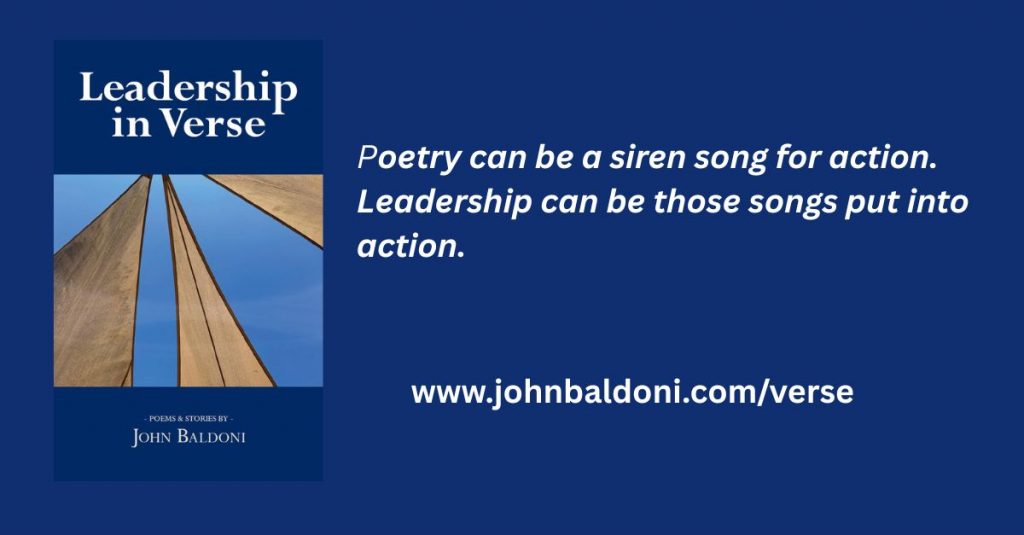
Turning Leadership Lessons into Poetry

The challenge to lead is ever-present. Leadership in Verse by John Baldoni reveals how to lead in times of challenge and stress by providing courage, compassion and grace. 

“Poetry is a medium that appeals to leaders because it speaks to the heart as well as to the spirit,” says Baldoni who has authored 15 leadership books. “Leaders need time to reflect on what they are doing, why, and how they could be doing things differently. Poetry lends itself to asking such questions.”

The title — Leadership in Verse — could be interpreted in two ways. Leadership Inverse – when everything you do seems the opposite of what you should do. Or as written, Leadership in Verse – aspirations and behaviors put into meter.

The book contains three key sections:

What We See are observations of management that we see around us in good times and in bad. 

How We Act is a set of leadership thoughts and actions that come in handy in times of stress.

How We Act is a set of leadership thoughts and actions that come in handy in times of stress.

Poster graphics

Leadership in Verse contains a select group of poster graphics with words and images that provoke contemplation and reflection.

Leadership in Verse is Baldoni’s third published book of poetry. His recent book, Golf Lessons, was a No.1 Amazon release. Baldoni is the author of 15 books covering topics such as purpose, presence and grace. He is a globally recognized communications coach and keynote speaker. Leadership in Verse is published by Maison Vero.

Leaders looking for insights — and readers looking for inspiration — will find Leadership in Verse a worthy addition to their leadership library.

Pope Leo: Focus on Our “Better Angels”

“I would like to invite you to a very practical and frequently unappreciated form of abstinence: that of refraining from words that offend and hurt our neighbor.”

These words are contained in a message from Pope Leo XIV about how to observe Lent, a Christian tradition marking 40 days before Easter. As a Catholic School kid, my friends and I marked the season by what we would give up – notably candy and maybe even a favorite television program. We were abstaining, that is, depriving ourselves of what we enjoyed.

Pope Leo inverts the concept of abstinence from deprivation into affirmation, namely, not speaking ill of one another. It is a more affirmative approach to marking the Lenten season. Doing so reminds me of Abraham Lincoln’s First Inaugural Address when hoped to avoid war by acting on “better angels of our nature.”

A century and a half later, American-born Pope Leo says, “Let us begin by disarming our language, avoiding harsh words and rash judgement, refraining from slander and speaking ill of those who are not present and cannot defend themselves. Instead, let us strive to measure our words and cultivate kindness and respect in our families, among our friends, at work, on social media, in political debates, in the media and in Christian communities.”

Fasting may help focus.

Pope Leo does advocate fasting as a Lenten practice. Fasting is a tradition in the Abrahamic faiths and in other faith traditions. Depriving oneself of food can focus the mind on what is essential and what is spiritual. And it is the nod toward the spiritual that opens us to the possibilities of what it means to be more human, that is, more open to listening to others. [The title of his Lenten message is “Listening and Fasting: Lent as a Time of Conversion.”]

By focusing less on what we give up, the Pope is advising us to give more. Sharing with others goodness rather than bitterness. As our public discourse becomes more rancorous, we can become more generous. Very easy to say but hard to practice when we are constantly poked and prodded by messages rooted in difference and distraction rather than togetherness and attention.

Be positive

Johnny Mercer put similar thoughts into song with composer Howard Arlen, called “Accentuate the Positive.”

Gather ’round me, everybody/ Gather ’round me while I preach some

Feel a sermon coming on here…

You gotta ac-cent-tchu-ate the positive/ E-lim-i-nate the negative

And latch on to the affirmative/ Don’t mess with Mr. In-Between.

You got to spread joy up to the maximum/ Bring gloom down to the minimum.

If we can heed the good words of Johnny Mercer and Pope Leo during Lent, then maybe we might extend the practice for the entire year, without, of course, having to give up candy.