How to Present When the Stakes Are High

Preset Style = Natural Lightness = Auto-Exposure Size = Large Border = No Border

The man at the podium ruffles through his notes written in longhand on a yellow legal pad. Then he pauses and looks directly at the two key decision-makers in the room. 

The man is Colin Sutton, a veteran London police officer asking for assistance to track down a burglar who has committed over 100 break-ins and has sexually assaulted many of his victims, most of whom are elderly women. Sutton describes the latest victims:  an elderly woman in hospital, a war hero who has been robbed and molested, and a woman who has died of her injuries. 

Direct. Human. And very personal.

One of the decision-makers replies, “Colin, you are pushing on an open door.” Finally, finally, Sutton and his team will have the resources they are requesting. While Sutton was expected – and had fully intended — to deliver a full-blown presentation using video and PowerPoint, time did not permit such extras. (Note: This scene appears in season 2 of Manhunt, a British television dramatization of a real-life case that Sutton and his team cracked in 2009. The role of Sutton was played by Martin Clunes.)

Sutton’s chief instrument was his ability to speak from the heart. The officers in charge did not need a professional presentation; they needed a credible argument. And Sutton, who had a stellar reputation for his past crime-solving efforts, was able to deliver it. 

Making Your Case

The lesson for managers is this: when the stakes are high, escalate your delivery method. Here are some suggestions.

Own the subject. Know what you are talking about. Use facts and figures to augment your case, but not overwhelm it. Spoon feed facts and surround them with stories that resonate with the audience.

Tell stories. Add life to your presentation by imbuing it with the stories of people who are involved, either as those affected by a lack of something or those who will benefit when the service is added. It is also good to give a shout-out to the people on the ground who are doing the heavy lifting.

Ensure credibility. Provide proof of delivery that is the ability to do what you say you will do. Address how you will solve the issue or lessen the pain. Speaking knowledgeably gives your presentation a sense of authenticity. Play up the experience of your team.

Radiate confidence. Show humility in the face of adversity, but make certain you project authority. Act as if you have been in this position before. Keep cool when being questioned. 

Changing minds

Presentations from the heart are intended to change minds. Sometimes it is to procure resources, as it was in Sutton’s case. Other times it is to create awareness of the need for action to solve a problem. Changing minds is never easy, and for that reason, it calls to the presenter to use the tools at hand—chiefly his mind and his voice—to open a metaphorical window into what it will take to do things differently.

Speaking from the heart to engage emotions is a powerful tool, but it must be used with care and caution. Make sure that what you argue is rooted, has a sense of urgency, and can be delivered. Without such a foundation, your argument may evoke emotions but not provoke action.

First posted on Forbes.com 12.00.21

Speak in Word Pictures

“For a few seconds at least, more seconds than that, there is no resilience in this material when it is at a temperature of 32-degrees. I believe this has some significance to our problem.” Those words were from Richard Feynman, Nobel Laureate in physics, explaining to a Congressional committee why the O-rings in the Challenger space shuttle exploded upon launch in January 1986.

Feynman was one of many scientists and learned experts contributing to the report on the disaster. Still, his simple statement made the complexity of what happened crystal clear to the public.

Feynman knew how to get his message across clearly. This lesson is what all good leaders know. And while this idea is obvious, leaders often forget it, not because they are ignorant or stupid but because they are caught up in the moment and forget that simplicity is the better answer.

Presidential words

Here are some great examples from history.

When Franklin Roosevelt addressed the nation in his first inaugural address in March 1933, the country was financially and emotionally prostrate. Millions were out of work. People wanted answers. What Roosevelt did was straightforward. His message was one of reassurance. “The only thing we have to fear is fear itself.” Doing so slew the dragon metaphorically. Yes, people were afraid, so they needed to get past the fear. Roosevelt offered a path forward. When John F. Kennedy addressed the media after the botched invasion of the Bay of Pigs in May 1961, he owned the problem. “Victory has a thousand fathers, but defeat is an orphan.”

Kennedy said, quoting an old adage. Even though the invasion had been planned under the Eisenhower administration, Kennedy went through with it and held himself accountable. 

In the wake of the slaughter of nine Black parishioners by a racist gunman, Barack Obama stood at the pulpit of Emanuel AME church where the slayings had occurred and intoned the spiritual, “Amazing Grace.” His vocalization encouraged the audience to join in as a gesture of solidarity in the face of unspeakable loss.

In each of these moments, the words were clear, and the message was even more apparent. Each president used words that painted vivid pictures: fear, orphan, and a hymn. The challenge for leaders is to integrate simplicity into their presentations, especially when addressing challenges and crises. Here are some simple tips to follow.

Address the elephant in the room. Play it straight if people are worried about a disaster, a plant closing, or even a new competitor. Don’t dance. Get to the main issue immediately. Failing to do so makes the leader seem as if he is avoiding something. 

Avoid nuance. Speaking around issues, or being too clever by half, may be okay for meetings or one-on-one communications, but it is deadly when addressing significant issues. 

Show and tell. Illustrate the problem with words that conjure images, just like Richard Feynman did when testifying to Congress. Bring photographs or related images. Avoid charts. Please keep it simple and to the point.

Celebrate heroes. Talk about what people are doing to solve the problem. For example, an IT programmer working overnight to re-route the electricity grid, or a first-responder rescuing a child from danger, spread the good word. Let people know that some good is happening for their benefit.

Provide hope. When big problems occur—natural disasters, failing infrastructure, school closings—people want answers. Now. Sadly, the answers are not always forthcoming. What leaders can do is play it straight. Tell people that you are mobilizing resources, and you will provide immediate assistance. Give them the hope that you care, and others do, too.

No leader will get it right all of the time, and so then it is wise to remember the words of poet Maya Angelou, “You may encounter many defeats, but you must not be defeated. In fact, it may be necessary to encounter the defeats, so you can know who you are, what you can rise from, how you can still come out of it.”

Simplicity in the fog of over-information, or more likely disinformation, is a virtue. It may not be easy to find, but it must be put into practice if the leader wants to bring people to her cause.

First posted on Forbes.com 00.00.2021

Christopher Nolan Gives a Blueprint for Motivating Your Team

Remember the popcorn to get something important across to your team.

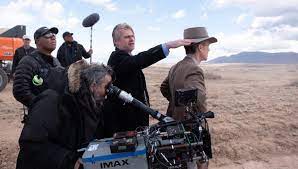
In an awards speech at Cinema Con 2023, Christopher Nolan, director of major motion pictures like Tenant, Dunkirk, Batman, and many others, stated his belief in the collective we in moviemaking. It includes “distributors, theater owners, marketers, [and] the people serving popcorn.” In that one statement, Nolan clarified that moviemaking is a team effort. “We all work in what is the greatest art form ever created, the one that combines pictorial beauty, two-dimensional, three-dimensional, sound, music, and language.”

Nolan’s nod to the distribution part of the motion picture is a welcome endorsement from a business that has seen its fortunes decline during the pandemic and due to the rise of streaming video networks.

Lessons from the speech

Nolan’s speech can serve as a template for any executive seeking to frame what the organization does, how it does it, and why it matters.

State the purpose. According to Nolan, those in the film business “are all engaged in a process that in some small way can make the world a better place.”

Iterate the why. “Does make the world a better place?” asks Nolan. “It’s an absolute good because we all work in what is the greatest art form ever created, the one that combines pictorial beauty, two-dimensional, three-dimensional, sound, music, and language.”

Touch the hearts. The film says Nolan “can combine the subjective experience of another human being the way a novel can, but it can combine that at the same time with the empathetic experience being in a theater and feeling what the rest of the audience is feeling. I’m often accused of magical thinking, nostalgia, of daydreaming as opposed to a sound business plan.”

Embrace the efforts of everyone. “It’s taken the last few years for us all to realize that when you’re talking about movies, magical thinking, nostalgia, and daydreaming, that is the sound business plan. It’s the only sound business plan. That’s what movies are. And whatever spires and aspirations and dreamlike stories are allowed to come out of this medium, stands on the foundation built in your theaters.” And that includes the people selling the concessions, like popcorn, to movie patrons.

Putting lessons to work

Managers who emulate what Nolan sketches are doing two important things. One, echoing purpose. Two, recognizing the contributions of everyone. Purpose becomes the lodestone; it is the rallying point for people to point to. Recognition fires the urge to contribute and do what is necessary to succeed. 

Or as Harry Truman once said, “It is amazing what you can accomplish if you do not care who gets the credit.” 

Special thanks to Nolan Anlyst for these insights.

First posted on Forbes.com 00.00.2023

Three Traits That Hold Us Back

The other day while playing a new piece of music on piano, I realized that I had been augmenting the opening 32 bars with a left-hand accompaniment. The only trouble is that there is no bass accompaniment; the entire opening is for the right hand only. 

The opening certainly does not need any added accompaniment; it is “Ashokan Farewell,” a sparse and mournful tune (written by Jay Ungar) that Ken Burns repeatedly used throughout his epic docu-series, The Civil War. The melody is instantly recognizable to anyone who has heard it. The opening notes evoke another time, another place. It harkens recollection of a time gone by but still, as the series reminds us, evocative of our era.

Ignoring what’s in front of us

Why I had insisted on playing a non-existent accompaniment did not come to me until later. Three reasons. Inattention. Habit. Ego. Each of them has a role in my misinterpretation, and I think they give us a reason to discuss why sometimes we fall into those traps.

Inattention. Laziness is a failure to pay attention. Since nearly all music I play has parts for both treble and bass, I played the bass part, even though it does not occur until later in the composition. I was not paying close enough attention.

Habit. Because I have “always” played the bass part, why not keep doing it? After all, why stop doing what’s working? Or, more accurately, what I think is working? Some habits (exercise, proper diet) are good; other habits like sloth are not.

Ego. Even after I recognized the error of my playing, I kept playing the left hand. Why? Because I thought was making the piece better. Ahem. Playing the bass before when it appears in the score undercuts the spareness of the work. The opening highlights the beauty of the melody. My addition did nothing to enhance it. It may even have diminished the richness of the piece when the bass line finally does appear.

Invention for its own sake

Music is endlessly creative. Improvisation is to be encouraged. Jazz, many will argue, is nearly always played improvisationally, even when the score is written and arranged. Musicians are encouraged to do their solos as a means of expression and find new ways to bring a tune to life. What I was doing with my left hand was not “wrong” in a musical sense. It was unnecessary.

We all have moments where inattention, habit, and ego are present in our personal and private lives. Unfortunately, these negative traits are part of our human condition. Our challenge is to hold them in check. To avoid such habits, consider two questions:

Am I inattentive to the need for change? Doing something new is hard at first. There is comfort in our habits. There is virtue in them, but when we keep doing things repeatedly because we are not thinking or too lazy to change, we may be shorting ourselves.

Is my ego speaking louder than what people need to hear? Ego is essential to leadership. It can be the inner call to action, which says I am ready to take charge. But if you are always in control and deny others their right to assert themselves, ego precludes team growth. A boss who never shares authority is a boss who never learns.

Music is a process of interpretation, and so too is leadership. It would be best to learn when to improvise and when to hold fast to what makes the best sense. Experience can provide answers. And in time, we may gain wisdom for a chosen course. But to do that, we must keep a watchful eye on inattention, habit and ego.

Post-script. Watch Jay Ungar, the composer and fiddler, play “Ashokan Farewell.” (Note to self: Listen how Mr. Ungar plays the opening without accompaniment.)

First posted on Forbes.com 8.13.2021

Getting (Un)Stuck in a Time of Flux

Feeling stuck where you are?

I don’t know if you should go or stay.

Well, you are not alone. According to a Society for Human Resources study,  more than half of all employees surveyed are considering changing jobs. It’s part of a trend called “The Great Resignation.” 

As a result of the lockdowns caused by the pandemic, the unsettling feeling people have about where they are now and where they might want to go, many employees are considering changing jobs. A key reason is burnout and the sense that they are stagnating in their current position. 

Additionally, according to the 2021 Edelman Trust Survey, employees have “considerations such as the company’s stance on social issues, or its policies on employees’ ability to express their political beliefs.” Additionally, more than three-quarters of employees say they feel “more empowered, either by working within their organization or taking issues public.” 

And employers know this. According to a report cited in Axios, “60% say their employees have more power and more leverage than they had before the pandemic.” 

Making your choice

On the plus side, it’s an excellent opportunity to consider your options. There are many unfilled vacancies, and companies are engaged in a war for talent like never before. Bonuses are not uncommon.

Before you leap, however, consider where you are now. Making a move for money may be tempting. Still, if you are trading one position for another, you may soon be disappointed without an increase in responsibility or change of culture. You have three choices. The first two are obvious: leave or stay. The third requires some forethought: change.

Leave. Consider your next position. Ask yourself why you are leaving—more pay, bad boss, bad culture, change of scenery. All of these are valid reasons. What is not so obvious is what will be different. Yes, you make more money, which is a good thing, but if the only thing other is the scenery, you may become frustrated quickly. When leaving—assuming it is your choice—you want to make sure you will have the opportunity to pursue your skills and broaden them. You will want more responsibility as well as new challenges.

Stay. Remaining in place is what most people do. Saying you want a new job may be a matter of thinking out loud. It’s a response to a flavor of the month, a kind of restlessness. When you consider your options, you release that while the grass may appear greener on the other side of the proverbial fence, you have all the “green” (income, benefits, seniority) where you are now.

Change what you are doing. Rather than thinking about jumping ship, consider rocking the boat you are already in. Consider what you could do differently. You know the system, and as such, you may know ways to change things. You know the players, too. Whom can you enlist to help you make changes that would benefit the organization? 

Leave, stay or change are three options. The answer to each may require deep thinking. And in itself that is a good thing because you know what you do will be better for you. You may not be participating in the Great Resignation. But better yet, you will not be resigned to your condition. 

You will have made a decision, and that is a positive step. Your career depends on what you do, when you do it, and how you do it. You will have made the first in a series of changes that work best for you.

First posted on SmartBrief.com 9.17.2021

Barbara Kellerman Keeps Teaching Me

There are leadership authors, and then there are LEADERSHIP authors. I put myself in the former and Barbara Kellerman in the latter. As the author of 20 books on leadership and a professor at many institutions, including Dartmouth, Tufts and Harvard, where she is a Fellow at the Harvard Kennedy Center, Professor Kellerman is one whose leadership writings have deepened my knowledge.

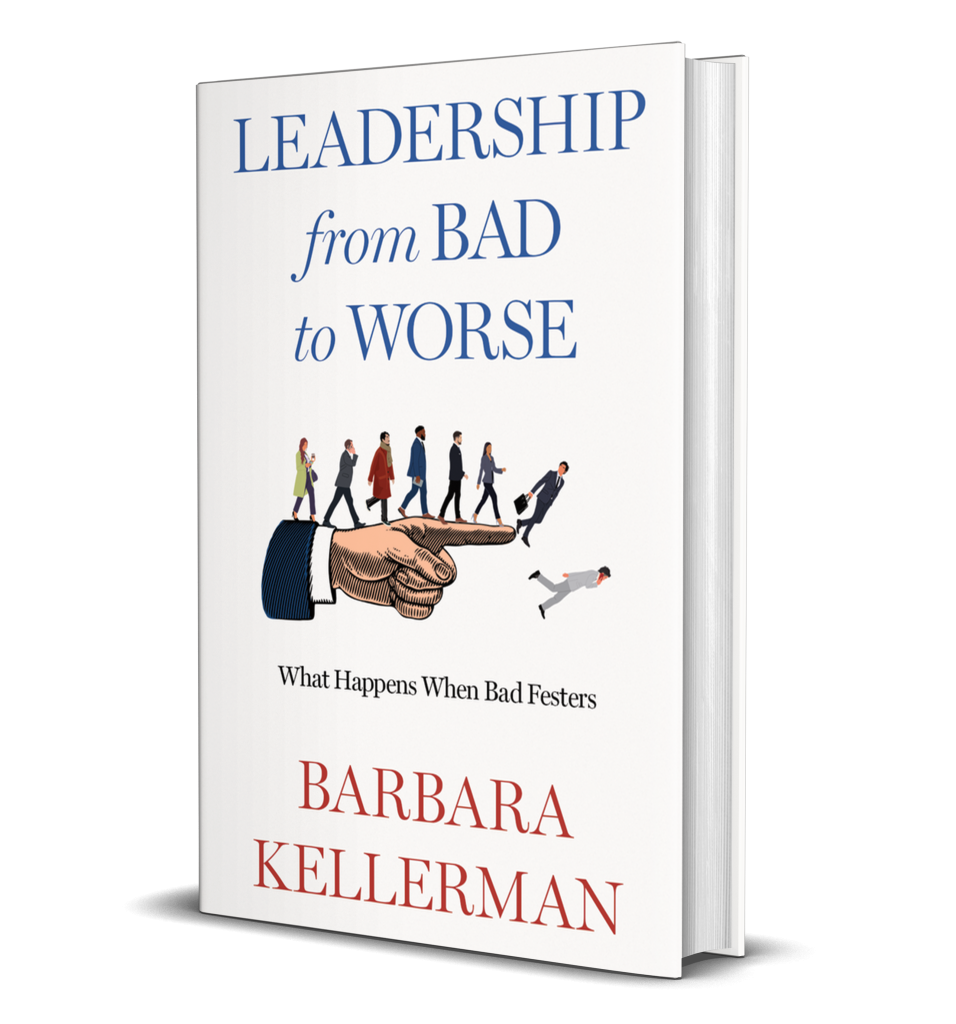
Now, her new book, Leadership from Bad to Worse: What Happens When Bad Festers, is another one that spotlights what happens when leadership becomes toxic—as she has done previously. 

Professor Kellerman explained in a recent interview, “Why does humankind, forevermore, put up with what I call the social disease of bad leadership? We address physical diseases, cancer, heart disease and aids, and we address mental or psychological diseases such as schizophrenia. We attack all of those mental diseases, physical diseases, but we do not attack, we do not study, we do not think about what I call the social disease of bad leadership.” The consequences for a nation or an organization and its followers can be hazardous, not to mention dangerous.

4-step model

Kellerman sketches a four-part model that describes the journey from positive to negative.

  • Phase I: Onward and Upward focuses on a better tomorrow
  • Phase II: Followers Join In, attracted by the vision and its energy
  • Phase III: Leader Starts In begins the crossing over into activities and practices that “left unchecked… will become worse leadership.”
  • Phase IV: Bad to Worse – what may have started as benign has become malign and “dismal.”

The prologue clarifies that what constitutes bad leadership is not confined to autocracies. Kellerman writes that executives at WeWorks, Wells Fargo, Uber and Purdue “went from being bad to worse.” She also calls out the toxicity of executives like Elizabeth Holmes of Theranos and Martin Winterkorn at VW. Holmes was a scammer; Winterkorn was a denier of emissions scandals.

A key point of Kellerman’s book is that leaders are enabled by their followers, who join in the conspiracy of evil and support the individual in power. There are such things as “bad followers,” who fail to hold the leader accountable and, in doing so, harm the organization and benefit from the leader’s malfeasance. 

Be vigilant

However, there is a light at the end of the misery of bad leadership. Kellerman sketches a 12-step plan: “The purpose of this list is particularly to provide ideas, information and instructions on how to know when bad leadership threatens and on what to do when it happens.”

Notably, step 12 says, “Pay attention to the progression – the invariable, inexorable progression. Bad leaders who are not slowed or stopped in Phase I will proceed to Phase II…” right through Phases II, III and IV. In short, pay attention. Know the situation, context and behaviors of others. Proceed carefully and work with others to stop the slide into evil.

“We need to take a stand,” says Professor Kellerman. “And Leadership from Bad to Worse, I make very clear where I’m coming from. I make clear that I understand not every reader will agree with my values, my ideas, my opinions, but that’s all we can do. We can just say where we’re coming from, try to have some kind of minimal moral compass and forge ahead.”

By studying what is malign, Kellerman reminds us that the dark side of leadership is part of the human condition, and it behooves us to study and learn from it so that we are alert, aware and active for the betterment of leaders and followers.

Note: Watch my full LinkedIn Live interview with Barbara Kellerman here.

First posted on Forbes.com 5.08.2024

Sally Helgesen: How We Can All Rise Together

Sally Helgesen has been writing about women’s leadership roles since the Eighties. Now four decades later, she has a new book, Rising Together: How We Can Bridge Divides and Create a More Inclusive Workplace. It brings her thinking about diversity, inclusion, and equity into sharp focus to illuminate a path forward that she calls a “culture of belonging.”

According to Helgesen, a culture of belonging is achieved when a majority of people “feel ownership in the organization, believe they are valued for their potential as well as their contributions, [and] perceive that how they matter is not strictly tied to their positional powers.”

Identifying triggers

A grand statement, yes, so how do we achieve it? The short answer is to change behaviors. According to Helgesen, when we become aware of how we are acting in the presence of others, we can identify what we need to do differently. As Helgesen told me in an interview, look for triggers (obstacles) that get in the way of our being our best around others. Such triggers include a lack of visibility, confidence, misperceptions, and poor use of humor. 

One trigger is unconscious bias. It is human nature to trust what we know and distrust what we don’t. Calling it out is appropriate, but we often focus on what separates us rather than what unites us. “It alienates us from one another… We’re constantly thinking, oh, well, this person’s background might be different,” and a sense of unease sets in. 

Worse, individuals who differ from the group by gender or ethnicity feel marginalized. “They feel stereotyped. They feel unheard. They feel under-recognized for their individuality. It’s not a good thing.”

Marginalization can occur even with good intentions. Helgesen tells the story of a younger client she was working with who had been invited to attend a corporate strategy session. It was senior management’s way of acting inclusively. As a more junior executive, the young woman was excited, only to find out that she, along with her colleagues, had been placed at the back of the room. Her client told Helgesen, “in order to say anything, I had to make my boss’s boss’s boss turn around to hear me.”

Takeaway lessons

The final chapter is a kind of handbook called “Formal Enlistment” for putting the Rising Together principles into practice. “It’s the informal engagement where you’re asking people to give you feedback on how you’re doing. You’re disclosing what you’re doing in a spirit of honesty, and you’re getting other people to feed other people’s feedback. It’s a great way to build relationships.”

For example, a section on how to have a meaningful conversation about an essential issue with a colleague. Coupled with this is a collection of best practices that include being specific in what you ask, limiting your time frame, and showing gratitude reasonably, not overdoing it.

Taking the long view

Reflecting on her work in the past, Helgesen says, “Women are in a lot better place than they were when I started working in women’s leadership 30 years ago.” Building an inclusive workplace for all will require “positive culture change that will benefit a broad range of people who may be under-recognized or undervalued in the workplace now.”

Note to see my full LinkedIn Live interview with Sally Helgeson, click here.

First posted on Forbes.com 02.00.2023

Riding into the Light of Our Times

Listen, my children, and you shall hear

Of the midnight ride of Paul Revere,

On the eighteenth of April, in Seventy-five.

These opening lines of “Paul Revere’s Ride” by Henry Wadsworth Longfellow are familiar to American schoolchildren. And so they—including me—grow up knowing the story of Paul Revere riding from Boston to Lexington to warn the Patriots that the British troops were headed their way. What followed the next morning were the “shots heard round the world,” sparking the American Revolution.

For most, however, Revere faded into quaint memory, a hero not quite forgotten but not well remembered. Fortunately, The Ride: Paul Revere and the Night That Saved America, by Kostya Kennedy, brings Revere to life fully, making him not simply a patriot for his time but a beacon for our time, too.

Bringing the legend to life

Revere was well-known in his time. Kennedy cites author Malcolm Gladwell’s depiction of Revere as a “connector,” that is, someone who met and mingled well with others, and so became a trusted resource. Everyone knew Paul Revere is a refrain that echoes throughout the book. How he became so well-known by everyone from leading Patriots like Sam Adams and John Hancock to British military officers, including General George Gage, is worthy of exploration. His traits are instructive to this day.

Connector. A respected tradesman, Revere became a Mason, a not uncommon association for Colonial Americans, including some of our Founding Fathers. He was loyal to his lodge and headed it. There, at the meetings, he became steeped in the patriot resistance to the Crown’s imposition of punitive taxes. Some of 

Innovator. Revere’s father was an immigrant from France who embraced the Colonial American ways, becoming a silversmith, a trade he passed along to his son. Revere used that skill to teach himself to become an engraver and later a dentist, fashioning implants for his patients. He also learned to roll copper, becoming a bellmaker and munitions maker during the War of 1812.

Stamina. We know Revere for his 20-mile Ride that fateful night in April 1775, but Revere made many more rides, in particular, riding to and from New York and onto Philadelphia and back to Boston, a journey of 700 miles. He was carrying messages from Committees of Correspondence discussing how they would react to ever-tightening coercive acts by the Crown. As an expert horseman, Revere had the skills to keep a steady pace and stamina to ride night and day, stopping occasionally for an overnight rest and to switch horses.

Courage. During Revere’s Ride, he knew full well that someone like him could be stopped and detained and even slain if he were caught. And just outside Lexington, he was stopped by British officers who could have shot him on the spot. When they queried him, he told them exactly where he was going and why. Honesty was his trademark, and he was not about to lie, even to save himself. The officers instead stripped the bridle from his horse, Brown Beauty, leaving Revere to walk into Lexington rather than ride. 

Citizen. Revere was a Patriot. He lived his love of country through service to the cause of Liberty, yes, but also to service to his community. He practiced this as a tradesman, a member of his church, and a lodge master—a true communitarian.

Legend for today

These traits Revere demonstrated made him a trusted man in a dangerous time. We can take from his example that we should be open to change, find ways to maximize our skills, and stand true to our values. “It was Revere at the start and center of it all,” writes Kostya Kennedy. It was Revere, booted and spurred, who raised the resistance, who helped deliver the first, fateful stand.”

First posted on Forbes.com 5.10.2025

General Stanley McChrystal on Character

Another book on character?

Yes, that’s what I thought when I saw the title of Stanley McChrystal’s newest book, titled On Character: Choices That Define a Life.

When I heard General McChrystal speak about his new book and then read it, I realized it was different from many other books on the topic. Why? Because McChrystal, a retired four-star general, combat commander and West Point graduate, has lived it. He is also not afraid to call himself out when he has been deficient.

Many will remember that McChrystal offered President Barack Obama his resignation when an article in Rolling Stone magazine about his unit featured some negative comments about then-Vice President Biden and frustration with the administration’s handling of the war in Afghanistan. McCrystal, as he had been taught to do, took full responsibility. Obama accepted his resignation.

After more than 30 years of service, McChrystal was out of a job, a career, and a life that began as an Army brat born while his father was serving in Germany. That abrupt change is character-building.

What character means

And so when McChrystal addresses what it takes to lead with character, he knows of what he speaks – as the subtitle says: “choices that define a life.” Character is the spine that steels the spine in times of adversity and heals the soul in times of trial.

The idea for the book came from Annie McChrystal, his wife, herself the daughter of an Army officer. She nudged him to put down the many thoughts he had expressed to her over many conversations. As a result, the book has a discursive feel but is also very personal.

There are three sections to the book:

Conviction – beliefs upon which character forms

Discipline – the ability to follow through on what we believe

Character – the structure of life, e.g., “what we are willing to tolerate and what we are not.”

This troika casts the notion of character as foundational, practical and resilient.

Getting personal

There is a touching part of the book, one he spoke about to Amna Nawaz on PBS NewsHour. He admits he was not a good father because he put his career first. As he said, his son started high school when he went to Afghanistan, and then he went to Iraq and Afghanistan, where his son was in college. “I wasn’t a great father,” he writes in his book. “In retrospect, I regret things I didn’t do as a father, but, thankfully, avoided doing many things I would have regretted. If I could do it all again, I believe I would be a better father, but I don’t believe Sam could be a better son.”

Fortunately, as McChrystal tells Nawaz, “The beauty is, I get a second chance, because my son lives next door to me now, along with my granddaughters. So, I see him every day. We have a very close relationship. But you can’t make up for things you didn’t do.”

That’s a measure of character—facing the reality of the past while doing better in the present. Again, these are “choices that define a life” of self-awareness, integrity and truthfulness.

One of the reasons McChrystal wrote about character—and something he has reiterated on media appearances related to this book—is his desire to promote a national discussion of the role of character in society. Character is fundamental to leadership; without it, leadership is a position without moral conviction. Character, or rather the lack of it, is on full display in our culture when we see people in positions of power advocate for themselves rather than for those they are supposed to lead.

Living character

In their book Character Is Destiny, John McCain and co-author Mark Salter write, “Our character is a lifelong project, and perhaps the older we are, and the more fixed our shortcomings are, the more we can use inspiration to encourage our escape from the restraints of our deficiencies.”

Character is not being “holier than thou.” Character emerges from the frailty of the human psyche. It is a recognition rooted in self-awareness, knowing your strengths as well as your shortcomings. With that knowledge of imperfection, you live your life rooted in universal truths and lead your life in the practice of doing better for others.

First posted on Forbes.com 7.05.2025

When Is It Time to Retire?

When is it time to retire?

Pat Caputo, a long-time Detroit sportswriter and radio host, posed this question on his radio show about the status of Miguel Cabrera, who has won two MVP awards as a Detroit Tiger. He has slugged 500 home runs and racked up over 3,000 hits, including 600 doubles.

Caputo, an award-winning sports commentator with Hall of Fame ballot credentials, wonders if Cabrera – at age 40 and with a bum knee – is more a liability than an asset. Cabrera is a shadow of the player of his Triple Crown year, hitting under .200 and unable to hit for power.

The question of retirement is relevant to us all. One factor Caputo mentioned is to consider is the issue of respect, so let’s explore it.

Pat Caputo, a long-time Detroit sportswriter and radio host, posed this question on his radio show about the status of Miguel Cabrera, who has won two MVP awards as a Detroit Tiger. 

Caputo, an award-winning sports commentator with Hall of Fame ballot credentials, wonders if Cabrera – at age 40 and with a bum knee – is more a liability than an asset. Cabrera is a shadow of the player of his Triple Crown year, hitting under .200 and unable to hit for power.

The question of retirement is relevant to us all. One dimension to consider is the issue of respect, so let’s explore it.

Respect for the game. Cabrera will make $32 million this year. That’s a lot of money, even in baseball terms. His contract was negotiated a decade ago by the late Mike Ilitch, owner of the Detroit Tigers. Cabrera was wise to sign the deal; Ilitch was foolish to offer it. Too much money for too little productivity shows too little respect for the integrity of the game.

Respect for the organization. An unproductive player on the bench denies another player the opportunity to produce for the team – on the field and at the plate. A major league roster contains 26 spots. It is up to management – general and on field – to determine when to pull a player’s roster spot. 

Respect for self. Cabrera was lean, agile, and powerful when he entered the league at 18. Twenty-two years later, he is heavy, slow, and weak at the plate. Some say that kids watching him now see an “old man,” not a graceful and gifted athlete. Is he harming his reputation by hanging on?

Stay the course

Cabrera is revered – and rightly so – by baseball fans in Detroit and elsewhere. He is the best position player I have seen in person, including players like Mickey Mantle, Yogi Berra, and Al Kaline, to name just three. In his prime, Miggy was like the big kid in Little League that no one could get out. As Caputo notes, there was a sense of electricity about his every plate appearance and a sense of joy that he radiated playing the game he loved. His enthusiasm lifted his teammates and his fans.

The counter-argument is that he is an ambassador for the Tigers, an icon representing athletic prowess and a solid team ethic. Miggy is what baseball people call a “clubhouse guy.” He is a team-first player and a mentor to younger players. That said, by remaining on the active roster, the question becomes, at one point does he become more mascot than the player, and if so, when does he make way for the next guy?

Application to leaders

Leaders, considering stepping down, can ask themselves this question: am I respecting the community, organization, and myself? It is better to answer that question for yourself in ways that respect the needs of the whole rather than have others make it for you. “Everyone should be respected as an individual,” said Albert Einstein, “but no one idolized.”

As the saying goes, Father Time does not play favorites, even fan-favorite ball players.

First posted on Forbes.com 05.00.2023